
Net Metering in Maine: How It Works — and Why It Matters for Solar Savings
Updated May 2026
Maine homeowners are choosing solar for a simple reason: they want control. Control over rising electric bills, control over what happens when the grid goes down, and control over what they pay for energy five or ten years from now.
Net metering is the policy that makes that possible.
Without it, solar would still reduce your energy use — but you’d lose the value of every kilowatt-hour your panels produce beyond what your home uses in real time. Net metering captures that value and puts it back in your pocket, turning summer sunshine into winter savings and making solar work financially across every season in Maine.
With CMP rates rising and the federal solar tax credit no longer available, net metering has become the financial foundation of residential solar in Maine. Understanding how it works — and why it matters — is the first step to understanding whether solar is right for your home.
What Is Net Metering in Maine?
Maine’s net metering program — officially called Net Energy Billing — lets solar homeowners share extra power with the grid and earn credits that offset future electricity use. For every kilowatt-hour your system sends out, your utility gives you a one-for-one credit in return.
Net Energy Billing is available to residential customers of both Central Maine Power (CMP) and Versant Power under Maine’s statewide program. Your utility tracks every kilowatt-hour your home sends to and draws from the grid — and that’s how you earn and use the credits that lower your electric bill each month.
How CMP Net Metering Credits Show Up on Your Bill
Your CMP bill shows a record of how your solar system and the grid traded electricity over the month — how much power you sent out, how much you drew in, and the balance between the two.
For each kilowatt-hour (kWh) your system exports to the grid, CMP gives you a one-for-one credit. You can use those credits to offset future electricity use.
Each billing cycle, CMP compares those totals:
- If your system sent out more electricity than you used, the extra becomes credits on your account.
- If you used more than you produced, CMP applies your banked credits first, then bills you for the remainder.
Your bill can look confusing at first, but once you know what to look for, it’s straightforward. Note that you’ll still see CMP’s fixed delivery charge — approximately $27 per month as of 2026 — which covers your grid connection regardless of how much solar you produce. Net metering offsets your energy supply costs, but not that flat monthly fee.
How Net Metering Credits Roll Over in Maine
Credits carry forward on a rolling 12-month basis — meaning any credits earned in a given month must be used within that same month the following year. For example, credits earned in June need to be used by the following June. After that, any unused credits expire.
That’s why we don’t recommend oversizing your system. It should closely match your household’s annual electricity use. Our solar consultants design and size each system carefully to match your energy needs and maximize your savings — without leaving credits unused. And if your usage grows later — say, after adding an EV charger or heat pump — your system can be expanded to keep pace.
In Maine, solar production naturally rises in summer and dips in winter. Those sunny months help build the credits that carry you through the darker, colder ones. During high-production periods, many homeowners see their kWh cost drop close to zero.
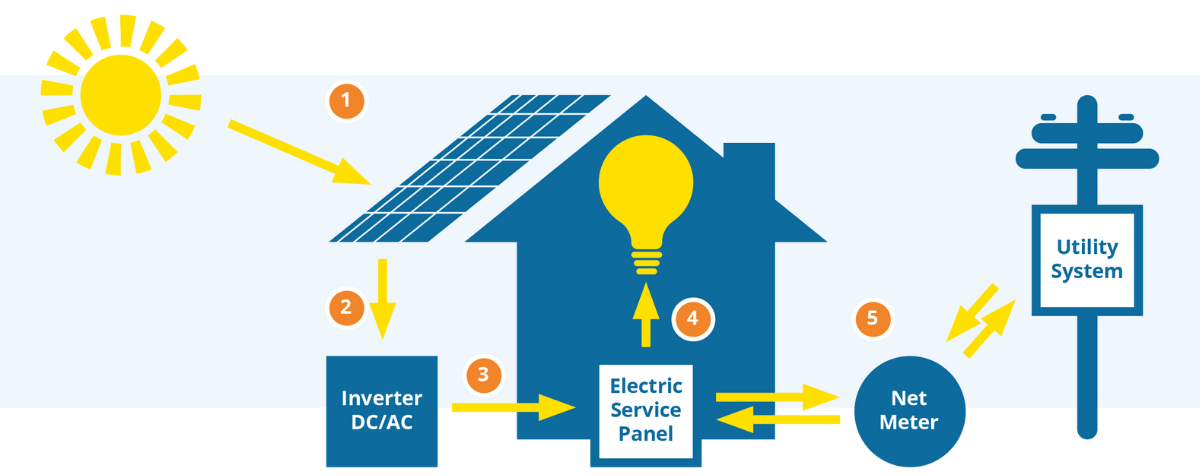
Your solar panels capture sunlight and turn it into electricity that powers your home. During the day, your home uses that solar power first. When your panels make more than you need, the extra electricity flows out to the grid — and you earn net metering credits for it. The diagram below shows how your home solar system connects to the grid. It traces the flow of power from panels to the inverter, service panel, and meter.
How to Track Your Solar Production and CMP Credits
Your CMP bill tracks how much power you import from and export to the grid, but it doesn’t show your system’s total production. That’s where your solar monitoring app — like SolarEdge — comes in.
Your monitoring app gives you real-time insight into how much energy your solar panels are generating. Comparing that data to your CMP bill gives you the full picture:
- How much of your solar power your home used directly
- How much went back to the grid to earn credits
- Whether CMP’s generation numbers align with your own system’s data
Think of your CMP bill as your energy statement and your monitoring app as your performance dashboard. Checking both each month helps you stay confident your system is performing as expected — and spot any changes in production quickly.
Using Solar Credits Across Multiple Properties in Maine
Maine’s virtual net metering policy lets you apply solar credits from one CMP account to another account under the same customer name.
Some homeowners choose to slightly oversize the system on their primary home so the extra credits generated in summer can offset usage at a camp, rental, or other property. For example, a homeowner in Brunswick might use extra credits from their main home to offset their Harpswell cottage account — a simple way to extend the value of solar beyond a single property.
Can Maine’s Net Metering Policy Change?
It’s a fair question — and one we hear often.
Net metering has been part of Maine’s energy policy for more than a decade and is overseen by the Maine Public Utilities Commission (PUC). You can view the full program details on the Maine PUC’s Net Energy Billing page.
While the program is periodically reviewed, most of the recent updates — including 2026 legislative discussions — primarily affect larger commercial and community-scale projects, not typical residential rooftop systems.
Maine’s Net Energy Billing program remains open and unchanged to new residential participants. Homeowners who install solar under today’s terms stay on those terms for the duration of their agreement (typically up to 20 years), even if the program changes for future residential installations.
That’s one reason many Mainers are choosing to go solar now: locking in today’s crediting structure protects the long-term value of the energy your home produces — regardless of what rates or policies look like down the road.
How Batteries Work with Net Metering in Maine
Adding battery backup makes your solar system even more flexible. Grid-tied systems automatically shut down during a power outage for safety, but with a battery, your home can stay powered using stored solar energy.
Because Maine’s 1-to-1 net metering already provides full credit for energy you export, we typically configure batteries in grid-tied systems as a backup power source — so you keep earning credits while having reliable power ready when the grid goes down. Unlike some states, Maine doesn’t use time-of-use rates, so your credits hold equal value day or night.
Batteries don’t replace net metering — they complement it, giving you more control, independence, and peace of mind. Learn more about how solar battery backup works in Maine.
How Net Metering Protects Maine Homeowners from Rising Electric Rates
Net metering is what makes solar practical — and financially worthwhile — in Maine’s seasonal climate. It lets you turn summer sunshine into winter savings and keeps your energy costs predictable year-round. It also gives you a real buffer against the rate increases CMP has proposed over the next several years.
The federal solar tax credit is no longer available. But net metering, combined with Maine’s rising utility rates, means the financial case for solar remains strong. Homeowners who install now lock in their savings structure under today’s rules — and protect themselves from whatever comes next.
Net metering isn’t just good for your wallet — it’s good for Maine. Every kilowatt-hour your system produces is one less pulled from fossil fuels, helping our state move toward a cleaner, more self-reliant energy future.
Common Questions About Net Metering
Maine’s Net Energy Billing program — often called net metering — gives homeowners a one-for-one credit for each kilowatt-hour (kWh) their solar system sends to the grid. Credits roll over month to month for up to 12 months and help offset future CMP bills.
Yes. In Maine, credits can be used for up to 12 months on a rolling basis — what you earn in June must be used by the following June. After that, any unused credits expire.
Not completely. In Maine, you’ll still pay CMP’s fixed monthly delivery charge — approximately $27 per month as of 2026 — which covers your connection to the grid. Net metering offsets your usage costs, not that flat service fee..
Yes. Net Energy Billing is available to most residential customers of both Central Maine Power (CMP) and Versant Power under Maine’s statewide program.
The Maine Public Utilities Commission (PUC) periodically reviews Maine’s net metering policy, but most proposed updates focus on larger commercial systems. Maine’s Net Energy Billing program remains open and has not changed for new residential participants. Homeowners who install solar under today’s terms stay on those terms for the duration of their agreement — typically up to 20 years — even if the program changes for future installations.
Yes. Maine’s 1-to-1 net metering credit structure, combined with rising CMP rates, means solar continues to deliver meaningful long-term savings. Homeowners who install now lock in their crediting terms and protect themselves against future rate increases — without needing an incentive to make the numbers work.
Ready to See How Solar Could Work for You?
At Maine Solar Solutions, we’ve helped more than 3,500 Maine homeowners design solar systems that maximize long-term savings through net metering.
Our team guides you through every step — from local permitting and utility coordination to final net energy billing enrollment — so your system is installed, approved, and earning credits as smoothly as possible.
Together, we’ll design a solar solution that fits your home, your budget, and your energy goals.
Schedule your free, no-pressure consultation with our Maine-based team today — and see how net metering can help you save.



